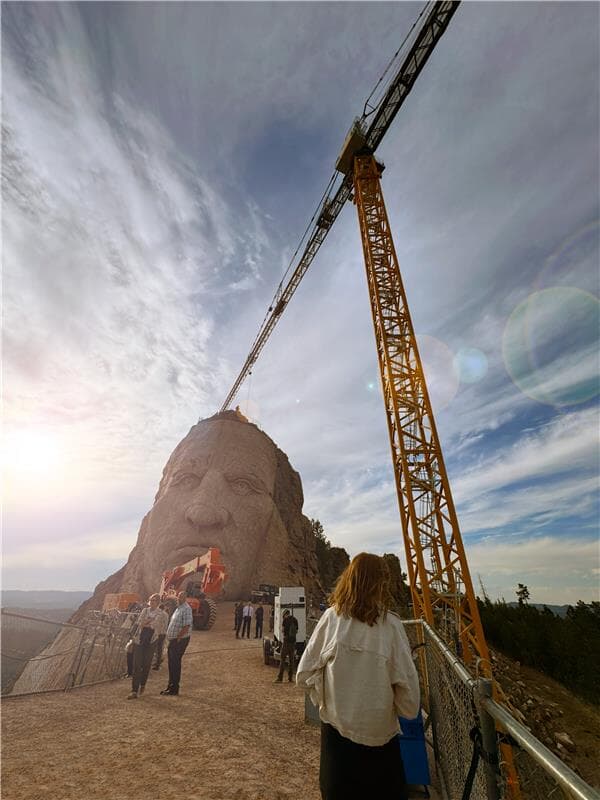
Crazy Horse Memorial Project Recognized With Outstanding Engineering Achievement Award
April 6, 2026
RESPEC has received the Outstanding Engineering Achievement Award for its work on the Crazy Horse Memorial tower crane foundation in the Black Hills of South Dakota from the South Dakota Engineering Society (SDES) Black Hills Chapter.
The award recognizes engineering projects that demonstrate a high level of technical complexity, innovation, and impact. RESPEC’s work addressed a challenge with no standard solution: designing a stable foundation for a large tower crane installed directly on a steep mountainside.
To make this possible, RESPEC engineered a rock-anchored foundation system capable of resisting millions of pounds of force. The solution includes 16 anchors extending 50 feet into the mountain, paired with an 8-foot-thick reinforced concrete mat. The system was validated using advanced modeling and custom laboratory testing to account for the unique properties of the site’s granite and schist formations.
“Projects like this don’t come with a playbook,” said Brett Belzer, PE, rock mechanics supervisor at RESPEC. “The team had to develop new testing methods and design approaches to make sure the foundation would perform exactly as intended in a very unforgiving environment.”
The crane foundation is already changing how work is performed at the Crazy Horse Memorial. With a reach of more than 250 feet, the crane can access areas of the mountain that were previously difficult—or impossible—to reach, improving safety and accelerating construction progress.
The project team brought together expertise from across RESPEC, including structural and geotechnical engineers in Alaska. Engineers Jacob Horazdovsky and Cody Kreitel contributed experience working in remote, rock-controlled environments, helping shape a solution where standard approaches wouldn’t apply.
Beyond the engineering challenge, the project carries broader significance. The Crazy Horse Memorial is a decades-long effort to honor Native American heritage, and improved access to the mountain supports continued progress on a monument intended to stand for generations.
“There’s a lot of technical complexity here,” said Brett. “But at the end of the day, it’s about being part of something with lasting cultural and historical importance.”
The project team also included partners who helped with drilling, construction, and crane installation, bringing together the expertise needed to deliver a solution that will support continued progress on one of the country’s most recognizable monuments.