Underground Injection Control: Solving Water Treatment’s Hardest Problem
Article
Across the United States, water treatment demand continues to rise because of population growth, systems using poorer quality raw water to meet demand, and increased chemical removal requirements. Water and wastewater treatment is solving one problem while creating another. As contaminants are removed from water, the question of what remains is becoming harder to address, more regulated, and more expensive.
The challenge extends beyond treating the water itself. Municipalities, utilities, and industrial operators are investing in advanced treatment processes to meet tightening water quality expectations. Technologies such as reverse osmosis and microfiltration effectively remove contaminants, including per- and polyfluoroalkyl substances (PFAS) and high levels of dissolved solids.
What remains is a concentrated residual stream, often a brine, that cannot be discharged into surface waters, applied to land, or sent to conventional treatment facilities in many locations. As disposal options narrow, they become a critical factor in treatment planning.
This is where underground injection wells come into focus.
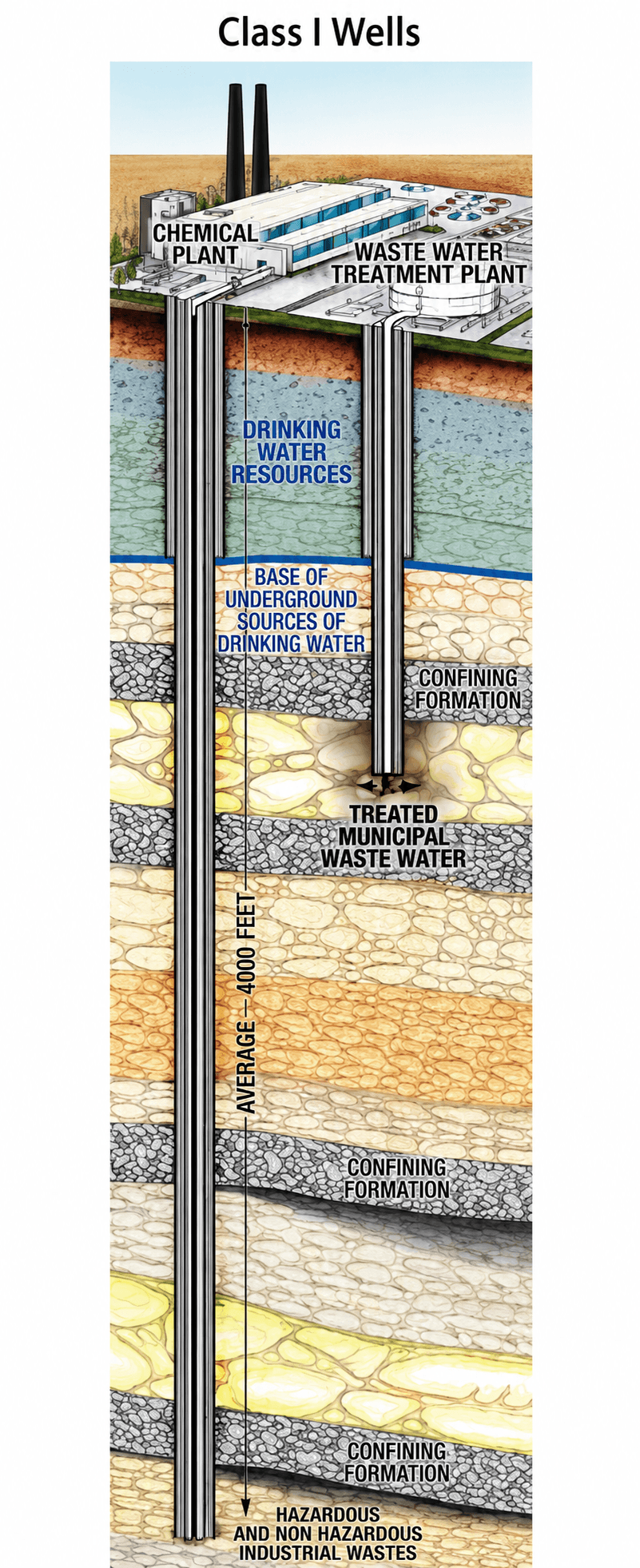
Cross-section diagram of Class I UIC wells. Click to enlarge.
Injection wells place fluids thousands of feet below drinking water sources, in deep, confined geological formations isolated from usable groundwater. They are not a shortcut or a temporary measure; they are a permanent disposal solution. Injection wells are among the most regulated types of disposal systems, requiring detailed geological evaluation, pressure and plume modeling, and multiple layers of well construction and monitoring to demonstrate long-term containment.
As Greg Casey, RESPEC’s Director of Underground Injection and Disposal, explains, “You’re going down thousands of feet below the drinking water, with multiple layers of protection to place the wastewater. The federal and state permitting process is designed to show that the fluid will remain where it’s placed for thousands of years and not migrate back up.”
Greg brings 4 decades of experience with underground injection wells worldwide, including leading municipal and industrial projects from early feasibility through permitting, construction, and long-term operation. His background includes supporting municipal and industrial injection systems that have operated successfully for decades, providing firsthand insight into how these systems perform over time and how they hold up as standards and expectations evolve.
That experience now strengthens RESPEC’s contribution to injection well projects.
Historically, RESPEC has supported injection wells through critical components such as subsurface modeling, drilling, and surface facility design. Under Greg’s leadership, those capabilities come together into an integrated, s holistic approach. Injection projects require a clear understanding of the subsurface, a permitting strategy built for long-term compliance, and the ability to carry a project from early evaluation through operation.
“If you can use an injection well, we can help from start to finish,” Casey says. “From understanding the subsurface to permitting to building the facility, and drilling the well and helping operate it.”
That integrated perspective matters. Evaluating disposal options early enables organizations to compare alternatives realistically, understand long-term costs, and avoid reactive decisions driven by new requirements. It also shifts the conversation from short-term fixes to solutions designed to last.
“Injection wells take the waste out of the active environment,” Casey notes. “Once it’s properly placed, you don’t have to keep moving the problem from one location to another.”
Why this matters
For many organizations, disposal decisions are still treated as an afterthought, addressed only after treatment requirements are underway. As expectations tighten around persistent contaminants such as PFAS, that approach increases risk, cost, and uncertainty.
Planning for disposal early changes the equation. Treatment projects move forward with fewer surprises. Budgets become more predictable. Compliance becomes a planning exercise rather than a reactive measure. Communities gain confidence that waste is being managed responsibly and permanently.
By combining decades of injection well experience with RESPEC’s subsurface, engineering, and environmental expertise, clients gain more than a disposal option. They understand what is possible, make long-term decisions with confidence, and move forward with a practical plan as water-treatment.
Related Content
Salton Sea Geothermal System
Presentation
RESPEC Mining & Energy Quarterly Newsletter – December 2025
Newsletter

RESPEC Mining & Energy Quarterly Newsletter – September 2025
Newsletter