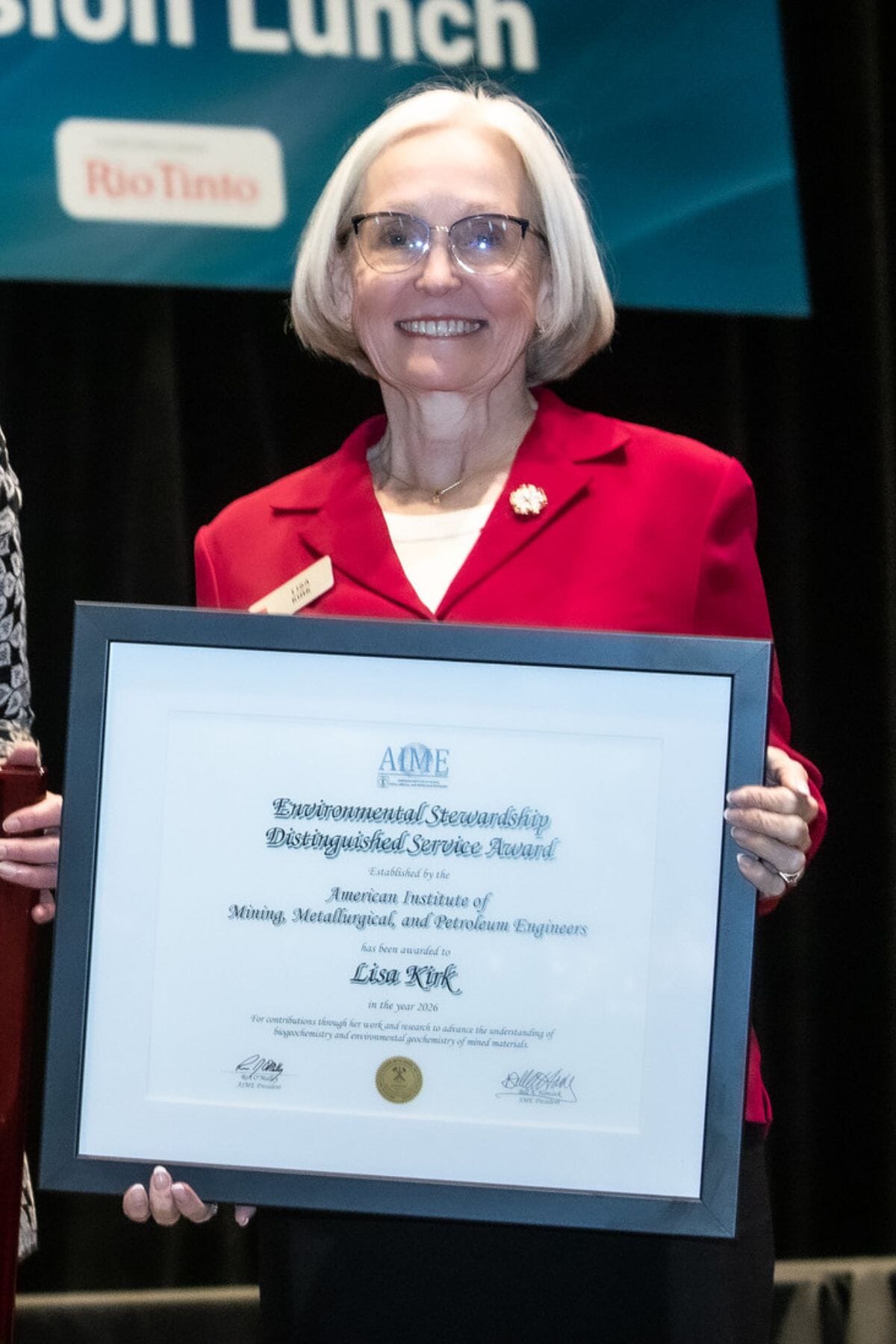
Dr. Lisa Kirk Honored for Lifetime Contributions to Environmental Stewardship in Mining
March 31, 2026
For decades, Dr. Lisa Kirk has worked at the intersection of two realities. Society depends on mined materials, and it also depends on clean water and healthy ecosystems. Her career has focused on helping the mining industry navigate that balance.
This year, Lisa was recognized for that work with the Environmental Stewardship Distinguished Service Award, presented through the Environmental Division of the Society for Mining, Metallurgy & Exploration (SME). The award honors individuals whose careers have advanced environmental stewardship in the mining industry.
Lisa received the award for her contributions to advancing the understanding of biogeochemistry and environmental geochemistry of mined materials. Her work has helped mining companies better understand how rock, water, and biological systems interact and how those interactions influence long-term environmental performance.
Over the course of her career, those insights have shaped how mines are designed, operated, and ultimately closed.
Understanding What Happens Beneath the Surface
Much of Lisa’s work focuses on one of mining’s most complex environmental questions. How do mined rock and water interact over time?
When rock is exposed during mining, chemical reactions can change water quality. Managing those reactions requires a deep understanding of geochemistry and water systems. Over the last 2 decades, Lisa’s work has increasingly incorporated microbial processes, which can significantly influence how quickly chemical reactions occur in mining environments.
By combining geochemistry, microbiology, and field testing, Lisa and her collaborators have helped mining companies design systems that better manage mine water and reduce long-term environmental impacts.
“The goal is to help companies do it right from the beginning,” Lisa said. “If you understand these processes early in the life of a mine, you can avoid problems later.”
Her work supports mines at every stage of the life cycle, from early planning and permitting to active operations and closure.
A Career Shaped by Curiosity
Lisa’s interest in environmental science began early. The first Earth Day in 1970 sparked a curiosity that carried through science fairs, university research, and eventually graduate work in environmental science and geology.
Over time, Lisa’s work expanded from geochemistry into the emerging field of biogeochemistry, exploring how microbes influence environmental processes in mining systems.
Along the way, she also built something of her own. While pursuing her PhD, a client encouraged her to continue supporting an active project rather than stepping away from the work. The situation ultimately led Lisa to found Enviromin, the environmental consulting firm that would later become part of RESPEC’s mine water service.
What began as a practical solution grew into a company known for advancing environmental geochemistry and biogeochemistry in mining.
“This has always been a team effort,” Lisa said. “No one does this alone.”
From Research to Real-World Impact
Over the years, Lisa’s work has helped shape environmental management strategies at mining operations across North America. One widely recognized example is work in the Elk Valley in British Columbia, where Lisa and her collaborators helped develop saturated rock fills designed to reduce contaminants in mine water before it leaves a site.
Projects like this demonstrate how scientific research can translate directly into operational improvements. The approaches Lisa helped develop have been applied at large commercial scale and adopted by mining companies seeking more effective ways to manage mine water.
“When you see new operations with fewer long-term problems and lower costs over time, that’s how you know the work is making a difference,” Lisa said.
As Mineral Demand Rises
The importance of this work continues to grow. Global demand for critical minerals is expected to increase significantly in the coming decades. These materials support energy infrastructure, electronics, and renewable technologies. Meeting that demand responsibly will require better environmental tools and smarter mine design.
“If we’re going to produce significantly more materials, we have to do it more efficiently,” Lisa said. “We cannot simply multiply the impacts. We have to find ways to reduce them.”
Even with the recognition, Lisa sees the award as part of an ongoing effort as the challenges facing mining and environmental protection continue to evolve. The need for better solutions will only grow.
“We are not going to stop needing mined materials,” she said. “And we are not going to stop needing clean water. The question is how we do both better.”
For Lisa, that work continues.