Understanding Rapid Cycling in Salt Caverns
Projects
Client
Solution Mining Research Institute
Timeline
2010–2020
Location
Rapid City, South Dakota, and Clausthal-Zellerfeld, Germany
Research to Support Safer, More Flexible Underground Energy Storage
When Energy Demand Speeds Up, Salt Behavior Matters
As energy systems evolve, operators are using gas storage caverns and compressed‑air energy storage (CAES) facilities in new ways. Instead of traditional seasonal cycles, many caverns experience pressure changes over days or even hours. These shorter cycles introduce new questions about how salt behaves and how damage may develop over time.
In 2010, RESPEC launched a multiphase research program for the Solution Mining Research Institute (SMRI), in collaboration with the Clausthal University of Technology. SMRI’s goal was to better understand how faster cycling affects the long‑term performance and reliability of salt caverns used for energy storage.
Testing to Improve Confidence in Design and Operation
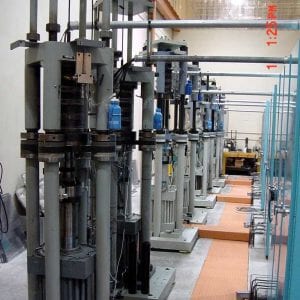
Over four phases, RESPEC conducted a series of laboratory tests to evaluate how salt responds to cyclic stress and temperature changes. Testing focused on key material behaviors such as creep, dilation, thermal expansion, and potential damage accumulation under repeated loading conditions.
The research also examined how salt performs both below and above critical stress limits, as well as how it responds to fluctuating temperatures like those experienced in active storage operations. Other testing investigated how repeated cycling influences permeability and mechanical properties over time.
Supporting Better Decisions for Energy Storage
The findings provide practical insight into how salt caverns behave under high‑frequency cycling, which helps operators and designers make more informed decisions about operating limits, pressure changes, and long‑term cavern integrity.
By reducing uncertainty and improving confidence in performance, RESPEC’s work supports the safe expansion of CAES.
The following research reports are available through the Past Research Projects section of the SMRI website. (A member login may be required for access.)
- Mellegard, K. L. and U. Düsterloh, 2012. High Frequency Cavern Cycling – Phase 2: Cyclical Loading Effects on the Dilation and Creep Properties of Salt, SMRI Research Report RR2012-2, prepared by RESPEC, Rapid City, SD, United States, and Clausthal University of Technology, Clausthal-Zellerfield, Germany, for the Solution Mining Research Institute, Clarks Summit, PA.
- Mellegard, K. D., 2013. High Frequency Cavern Cycling – Phase 2-B: Extensional Cyclic Fatigue Testing of Salt, SMRI Research Report RR2013-02, prepared by RESPEC, Rapid City, SD, for the Solution Mining Research Institute, Clarks Summit, PA.
- Buchholz, S., E. Keffeler, and U. Düsterloh, 2017. Cyclic Thermal Loading Creep Tests, RSI-2694, SMRI Research Report RR2017-3, prepared by RESPEC, Rapid City, SD, United States, and Clausthal University of Technology, Clausthal-Zellerfield, Germany, for the Solution Mining Research Institute, Clarks Summit, PA.
- Buchholz, S., E. Keffeler, and U. Düsterloh, 2020. Determination of Thermal Expansion Coefficient by Stress Controlled and Volume Controlled Triaxial Tests to Address Thermal Induced Stresses in Cyclic Storage Caverns, SMRI Research Report RR2020 2, RSI-3013, prepared by RESPEC, Rapid City, SD, United States, and Clausthal University of Technology, Clausthal-Zellerfield, Germany, for the Solution Mining Research Institute, Clifton Park, NY, United States.